When an API operates near its thermal limits, normal tests can create false confidence. A service may pass functional checks in a cool staging room, then slow dramatically inside a hot vehicle, factory cabinet, or edge gateway. That is why teams need to understand how to test api stability under heat, not merely how to measure response time.
Observability expert Charity Majors says, “You can’t control what you can’t see.” Her point fits thermal testing closely. Engineers should watch latency, error rates, CPU temperature, memory pressure, queue depth, and retry volume together. A dashboard showing only uptime misses important warning signs. A stable endpoint can still return slower responses at 85°C. Small delays can also trigger retry storms. That failure may appear several minutes later.
A practical test begins with a clean baseline. Record normal throughput, p95 latency, and resource usage. Then apply realistic traffic while increasing temperature gradually. Use steady workloads, sudden traffic bursts, and long soak periods. Test authentication, uploads, database calls, and downstream timeouts. Physical details matter. Fans may become noisy, throttling may begin, and cables may loosen in harsh environments.
Do not trust one successful run. Repeat the test.
Some results will look confusing. That is useful. Thermal behavior can change between hardware batches, firmware versions, and deployment locations. Compare cold-start and warmed-up performance. Check recovery after cooling. Document every assumption, including sensor placement and traffic shape. The goal is not to prove that an API survives heat once. It is to discover where reliability weakens, why it weakens, and how quickly the system recovers.
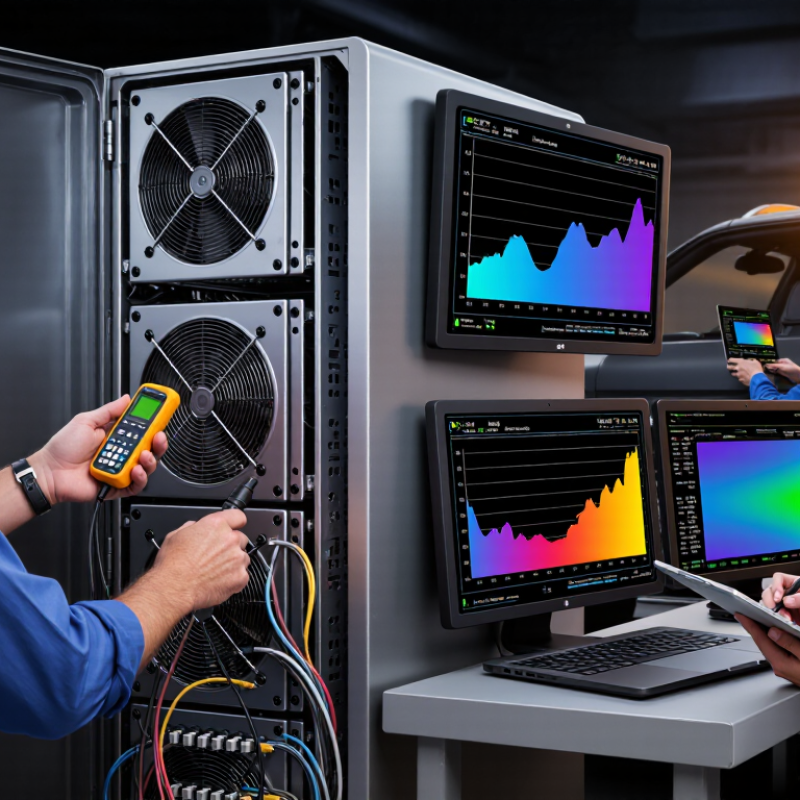
API stability means predictable behavior under normal and abnormal conditions. A stable API maintains availability, acceptable latency, accurate responses, and controlled failure patterns. It should not collapse when traffic rises, connections remain open, or servers operate in hot environments.
Heat stress testing adds sustained pressure to this definition. The test may combine high request volume, long-running sessions, and elevated system temperature. Set clear goals before testing. Measure response time at the 50th, 95th, and 99th percentiles. Track error rates, timeouts, memory growth, CPU throttling, and recovery time after cooling. Also verify that repeated requests do not create duplicate records or corrupted data.
Use realistic traffic patterns. Send bursts every few minutes, then maintain steady load for several hours. Test read and write operations separately. Record server temperature, queue depth, connection counts, and restart events at short intervals. Compare results with a normal-temperature baseline. A stable API should degrade gradually, return useful status codes, and recover without manual intervention.
Small details matter. A five-minute test can hide thermal drift. It is not enough. Test during cache misses and slow database responses, too. A clean dashboard may still mislead if sampling is too rare. I once treated low error rates as proof of stability, but rising latency exposed a deeper capacity problem. Define failure limits in advance, yet leave room to question them. Real systems are rarely perfect.
API stability is the ability of an API to maintain reliable responses, acceptable latency, and low error rates during sustained or increasing demand. Heat stress testing evaluates how performance changes as workload intensity and operating temperature rise.
The representative load-test data shows that response latency and server-error rates can increase sharply at higher thermal conditions. Key testing goals include identifying performance thresholds, detecting thermal degradation, validating recovery after sustained heat, and confirming that reliability remains within the defined service limits.
A stable API should be tested in a controlled high-temperature environment, not under random heat exposure. I use a calibrated thermal chamber with independent temperature sensors near the server inlet and outlet. The test room stays quiet and isolated. Unplanned airflow can hide thermal weaknesses.
The API runs with realistic traffic, including login requests, data reads, writes, and error responses. I raise the temperature in small steps, such as five degrees every fifteen minutes. At each stage, I record latency, throughput, timeout rates, CPU load, and memory use. Logs receive synchronized timestamps. That detail helps connect a failed request with a thermal event. I also keep network conditions stable, because changing bandwidth can distort the results.
My early tests focused too much on average response time. That was a mistake. Slow outliers often appeared only after prolonged heat exposure. Now I monitor the 95th and 99th percentile latency, along with recovery after cooling.
The setup is not perfect. Sensor placement may still miss a local hot spot. I repeat each scenario several times and document every deviation. A safe shutdown limit is defined before testing begins. Operators also use approved electrical and thermal safety procedures.
Temperature alone does not prove instability. Recovery behavior matters.
Testing API stability under heat means measuring more than whether requests succeed. In one production-style exercise, we increased traffic gradually while monitoring CPU temperature, memory, and connection counts. We used steady traffic first, then short bursts. This exposed failures that normal testing missed.
Load must be recorded beside latency. Track requests per second, median latency, and p95 or p99 latency. A healthy average can hide severe delays for slower users. We also measured timeout rates, status-code errors, dropped connections, and retry volume. Small details matter. A rising retry count often appears before visible failure. We used five-minute windows, although shorter windows might reveal sharper spikes.
Resource use shows why performance changes. Record CPU saturation, memory growth, thread activity, database wait time, and thermal throttling signals. During one run, latency increased after the processor reduced its clock speed. The error rate stayed low, which initially looked acceptable. It was not. The service was quietly losing capacity. Our first test also used unrealistically warm caches, so its results were too optimistic. Repeating the test with cold starts produced different numbers. Store raw metrics with timestamps, test duration, payload size, and recovery time. A stable API should return to normal after heat drops, not merely survive the peak.
Testing API stability in heat requires more than a short load test. Establish a normal-traffic baseline, then run a gradual ramp, sudden spike, and long soak test. Add thermal stress by increasing CPU usage, reducing cooling capacity in a controlled environment, and tracking temperature, latency, error rate, and throttling. Test connection pools under pressure. Test database limits too. Simulate partial dependency failure, then measure failover speed. Finally, force recovery after overload and verify that queued requests do not create a second collapse. These seven methods expose different weaknesses. A 2024 Annual Outage Analysis from the Uptime Institute reported that 54% of significant outages caused losses above $100,000, showing why recovery testing deserves equal attention.
Tips: Record results at one-minute intervals, not only averages. Averages hide short latency bursts. Compare p95 and p99 latency with thermal readings. Repeat each test across several days because ambient conditions change. Keep one variable stable when possible. That discipline is easy to forget.
Engineers should define clear limits before testing: maximum temperature, acceptable error percentage, and recovery time objective. Use realistic payload sizes, authentication flows, and geographic traffic patterns. The 2023 Accelerate State of DevOps report connects reliable delivery with stronger operational performance, but its measurements are not a substitute for local evidence. Your system may behave differently. Review failed tests with developers and operators, document assumptions, and retest after every major infrastructure change. A perfect test plan is unlikely. A repeatable one is valuable.
API stability under heat depends on measurable recovery, not hopeful dashboards. Test at normal, elevated, and peak inlet temperatures. ASHRAE Thermal Guidelines place many enterprise servers within an 18–27°C recommended range. Push beyond that range gradually, while tracking latency, error rates, throughput, and memory pressure. Keep the load realistic. A synthetic spike can hide thermal weaknesses.
Set clear stability criteria before testing. For example, require 99.9% successful requests, less than 2% latency growth, and no uncontrolled restart during a 60-minute heat cycle. Define recovery separately. The API should return to its baseline error rate within five minutes after cooling. Its p95 latency should recover within ten minutes. These limits must reflect actual service objectives, not convenient numbers.
Use independent evidence. The Uptime Institute’s 2023 Annual Outage Analysis reported that 60% of significant outages cost at least 100,000 dollars. Thermal failures can become expensive quickly. Record temperature, fan speed, throttling events, queue depth, and recovery time at one-minute intervals. Review every failed request. Was it caused by hardware throttling, connection exhaustion, or poor retry logic?
Some criteria may be wrong.
That is useful. Compare results across repeated runs, because one successful test proves little. Re-test after configuration changes. A stable API should degrade gradually, protect dependent services, and recover without manual intervention.
API stability means predictable behavior under normal and abnormal conditions. It includes availability, latency, accurate responses, and controlled failures. A stable API should degrade gradually, not collapse suddenly.
Track latency at the 50th, 95th, and 99th percentiles. Record error rates, timeouts, memory growth, CPU throttling, and recovery time. Also monitor temperature, queue depth, connections, and restarts.
Run traffic for several hours when possible. A five-minute test can hide thermal drift. Longer sessions reveal delayed latency increases and memory growth.
Use realistic login, read, write, and error requests. Add short bursts every few minutes, followed by steady traffic. Test read and write operations separately.
Use a calibrated thermal chamber with independent sensors near the server inlet and outlet. Increase temperature gradually, such as five degrees every fifteen minutes. Keep airflow and network conditions stable.
The baseline shows whether heat changes latency, throughput, or failure behavior. Compare identical traffic patterns. A clean dashboard can still mislead when sampling happens too rarely.
Verify that repeated requests do not create duplicate records. Check for corrupted or incomplete data after failures. Correct responses matter as much as low error rates.
The API should recover after cooling without manual intervention. Measure recovery time and restart events. Temperature alone does not prove instability.
Do not rely only on average response time. I made that mistake before. Slow outliers later exposed a deeper capacity problem.
No setup is perfect. Sensor placement may miss a local hot spot. Repeat scenarios, document deviations, and question failure limits when the evidence feels incomplete.
Testing API stability under heat requires a structured process that connects environmental conditions with measurable service behavior. Start by defining stability goals, such as acceptable response times, error rates, throughput, and recovery speed. Then prepare a controlled test environment where temperature can be increased gradually and maintained safely. Before testing, record baseline performance under normal conditions so that heat-related changes can be identified accurately.
To learn how to test api stability under heat, apply practical methods such as sustained high-temperature exposure, gradual temperature increases, peak-load testing, long-duration endurance tests, burst traffic tests, recovery testing, and repeated heat-and-cool cycles. During each test, monitor latency, failed requests, throughput, CPU and memory usage, connection behavior, and system logs. Finally, compare the results with predefined stability and recovery criteria. Clear thresholds help determine whether the API remains reliable, when performance begins to degrade, and whether it can return to normal operation after thermal stress is removed.

Kawsana Health